


You’re listening to The Morgan Snyder Show, the podcast for C-Suiters and Senior Leaders looking to get a competitive edge through publishing.
Before I get going, a quick word from today’s sponsor, Taelor.
You’ve got a big meeting, a speaking gig, maybe a client dinner, and the last thing on your mind is figuring out what to wear. That’s exactly what Taelor handles. A real stylist learns your lifestyle, picks your outfits, and ships them to your door every month. You wear them, send them back. They take care of everything else. No shopping, no laundry, none of it. Head to taelor.style and use code MORGAN25 for $25 off your first month. Link’s in the description.
Now, onto the show.
***
Apologies, friends! I was at a business summit last week in Texas and didn’t record the weekly episode.
But I am back and ready to rock. I’m sure many of you were very worried.
To start today, go to Google right now and search for one of your competitors. Look for their CEO and the rest of the C-Suite. Just type in their name and see what comes up.
Two or three years ago, you would have found a LinkedIn profile, a company bio page, possibly a press release if they’d raised money or made an acquisition.
Today? You’ll find podcast appearances. Articles they were quoted in. Newsletter archives. Maybe a YouTube clip from a conference. Their face, their voice, their opinions everywhere.
Now search your own name. What shows up?
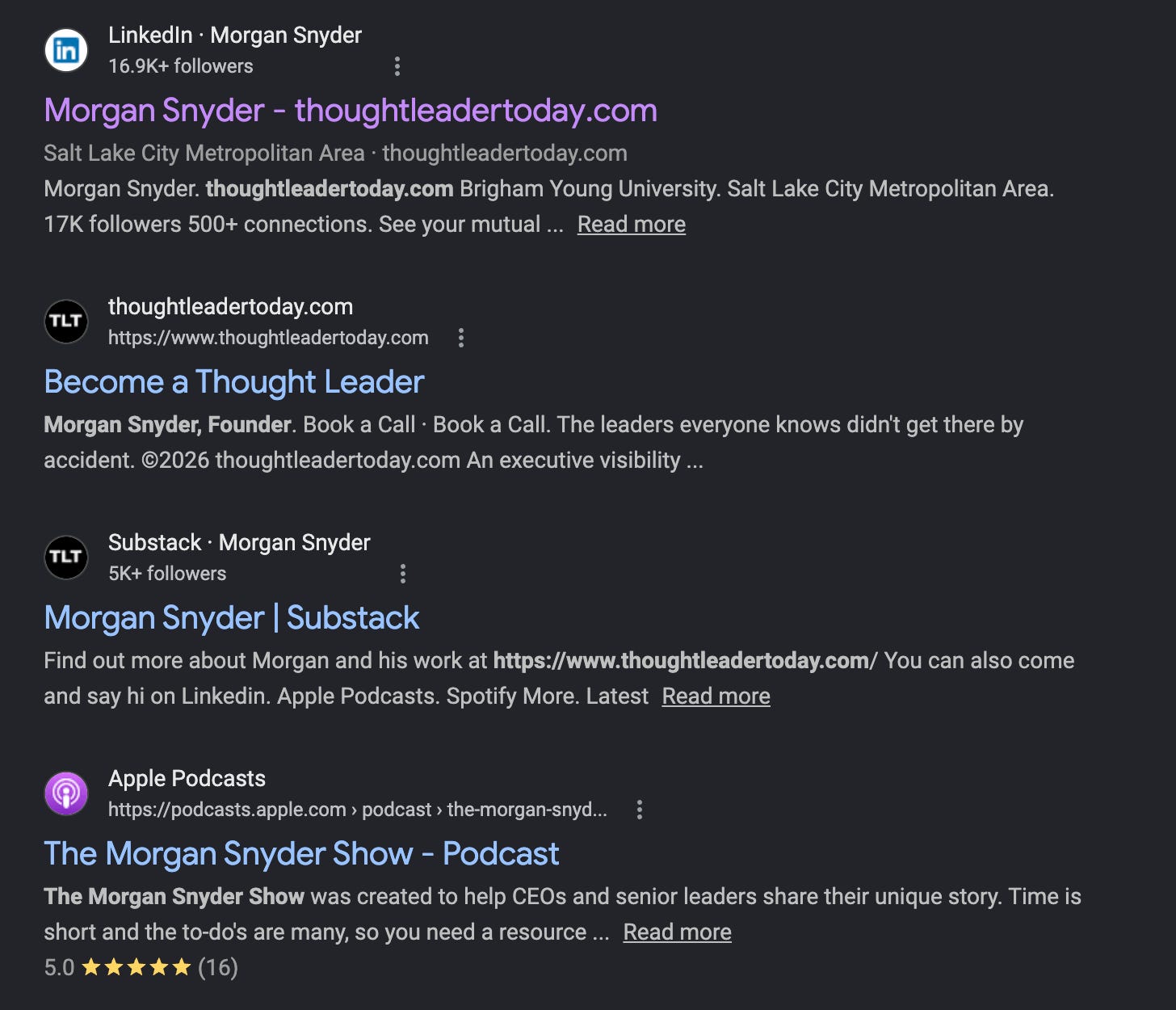
If the answer is “not much,” you’re not alone. I talk to execs almost on the daily about how they wish they weren’t invisible.
In the last few years, three forces converged and they’ve changed what it means for the average leader to get attention in their space. I’m not talking about “personal branding” in the influencer sense. I’m talking about the economics of attention, trust, and differentiation in B2B.
Let me walk you through each one.
Force One: The AI Content Flood
Ahrefs, (h-refs) one of the largest SEO analytics platforms in the world, analyzed 900,000 newly created web pages from April 2025. Their finding? 74.2% of those pages contained AI-generated content.
And that number is climbing. A follow-up survey found that 97% of content marketers plan to use AI for content creation in 2026, which is up from 90% a year earlier. Non-AI blog creation dropped from 65% to just 5% in two years.
So what does this mean for you?
It means the “quality content” your marketing team has been producing is no longer a differentiator. Everyone can produce polished blog posts, thoughtful LinkedIn articles, well-researched whitepapers. AI made the floor accessible to everyone. The bar for “professional” content is now underground. (although, I will say that I still don’t really understand what that means…)

Consumers know it too.
A recent report found that consumer preference for AI-generated content has dropped to 26%, down from 60% just three years ago. People can smell the synthetic. They’re tired of it.
They’re dying to hear a human voice that they can trust.
So if they don’t know your distinctive voice, they scroll past you too.
You’re just another person floating around in the polluted ocean of thought leadership content.
Force Two: The Trust Collapse
Every year, Edelman publishes their Trust Barometer, which is a global survey on who people trust and why. The 2026 report came out, and grievance has devolved into insularity.
70% of respondents now report being unwilling or hesitant to trust someone with different values, information sources, or backgrounds than them. Seven in ten. That’s a supermajority.
Trust has localized. People trust their family. Their friends. Their coworkers. Their neighbors.
Here’s the part that matters for you: while CEOs in general are distrusted, 61% of employees trust their own CEO. That’s the same percentage who trust their neighbors.
In other words, if someone knows you, they trust you at the level of a neighbor. But if they don’t know you? You’re at the level of any old corporation.

The Edelman data shows that “My Employer” is now the most trusted institution in the world, 78% trust, 14 points ahead of business in general, and 25 points ahead of government. People trust the specific over the abstract. The person over the entity.
It used to be enough to have a reputable company. Now, people need to know the human behind the company. The CEO. The founder. The leader they’d actually be doing business with.
If they can’t find you, they can’t trust you. And if they can’t trust you, they’re not buying from you.
Force Three: The Competition Changed
The CEOs who started posting on LinkedIn two years ago, three years ago, they now have legitimate audiences.
When a prospect is evaluating your company against theirs, they’re comparing the humans behind the companies. And if your competitor’s CEO has 50,000 followers, a newsletter, three podcast appearances indexed by Google, and you have...a company bio page? You’ve already lost the trust battle before the first sales call.
This is the part that feels unfair. You’ve been heads-down building a great company. You’ve been focused on product, on customers, on operations. Meanwhile, some other CEO has been posting on LinkedIn, and now they have an unfair advantage.
The creator economy grew up. It’s not just influencers and lifestyle brands anymore. It’s B2B. It’s enterprise software. It’s financial services and healthcare and manufacturing. The CEOs who understood this early are the default authority in their categories. The ones who didn’t are playing catch-up, or worse, they don’t even know they’re behind.
Every day your competitor publishes and you don’t, your relative invisibility increases. It’s compounding in the wrong direction.
The Convergence!
Any one of these forces would be significant. But they’re not happening in a sequence. This is a collision.
Force One means quality content is no longer a differentiator. Everyone can produce it. The only way to stand out is to be recognizably, unmistakably human.
Force Two means people don’t trust institutions anymore. They trust individuals. Specifically, individuals they feel like they know.
Force Three means your competitors are already building that trust. Every day they show up, they’re compounding an advantage you don’t have.
Put them together and you get a very narrow window.

Right now, visibility compounds faster than it ever has. The CEOs who build presence now will lock in an advantage that becomes nearly impossible to replicate. They’ll be the known quantity. The trusted voice. The person prospects have been following for two years before they’re even in-market.
After that window closes? The noise will be too loud. The trust too eroded. The cost of attention too high. You’ll be one more voice trying to break through a wall of content, competing against people who’ve already built relationships with your future customers.
I don’t want to get too negative with this.
There is a silver lining.
As I was talking to someone at Google who previously ran some AI division, he said that AI and those who use it are pushing everything toward the center.
It’s creating an unsatisfying sandwich of AI slop.
The positive note, amidst all these forces at work, is that there is an amazing opportunity for CEOs and C-Suiters who want to stand out and take big swings.
I’m encouraging all my clients to do so, and anyone that wrangles me on ‘quick coffee chats’ to go for it.
“I didn’t sign up to be a content creator!”
You didn’t sign up to be a content creator. Neither did I.
But the market is clearly signaling that visibility is no longer optional.
Just like your sales team, your marketing budget, your customer success organization -your presence is its own line item. The only difference is, unlike those other investments, this one doesn’t show up on a P&L.
It’s real and compounding, either for you or against you.
I referred to that tiny triangular window a minute ago, and the good news is it’s still possible to become a known voice in your market relatively quickly. The algorithms still reward consistency. The noise, while loud, hasn’t reached terminal levels. Your competitors, while ahead, haven’t locked up all the trust yet.
I don’t want you to be starting this work in 2028. By then, it’ll be too late for, “catching up.”
You’ll just be another voice in a crowd that already has its favorites.
The CEOs I work with didn’t start publishing content because they wanted to be famous. In fact, that’s the last reason they wanted to work with me. They started because they did the math and understood the window.
And now they’re on the other side of it, building trust, with a compounding asset that makes everything else in their business easier.
The question is whether you start now, while the window’s still open.
Or whether you keep paying the tax and hope nobody notices.
..
That’s the episode. If this landed, do me a favor: share it with one CEO you think needs to hear it. And if you want help actually doing this, go to thoughtleadertoday.com.
My friends: Keep pushing, keep publishing, and I’ll see you next time.


